Combining Wardley Mapping, Domain-Driven Design, and Team Topologies into a single, coherent approach.
Modern organizations face constant pressure to evolve. But changing strategy, redesigning systems, or reorganizing teams in isolation rarely improves the performance of the whole. Most improvement efforts fail because they optimize in the wrong place: teams reorganize without changing architecture, architecture evolves without a link to strategy, strategy shifts without understanding the landscape.
This leads to familiar symptoms:
- Slow delivery and long lead times
- Teams stepping on each other’s work
- Architecture that’s too hard to change
- Legacy friction everywhere
- Conflicting priorities across departments
- A lot of activity, but little real progress.
You’re not alone. These problems are systemic. They are socio-technical. And they cannot be fixed by looking at only one part of the system.
Architecture for Flow gives you a coherent way to connect strategy, software design, and team organization so your system can adapt, continuously and sustainably.
It brings together three powerful perspectives: Wardley Mapping (understand your landscape and strategic options), Domain-Driven Design (discover domains, boundaries, and models), and Team Topologies (design teams and interactions for sustainable flow).
Join Susanne Kaiser‘s Architecture for Flow Workshop and learn how these perspectives fit together to help organisations move with clarity and alignment.
Learning Objectives
You will learn:
- How to combine Wardley Mapping, Domain-Driven Design, and Team Topologies as a holistic approach
- Design adaptive, socio-technical systems optimized for flow of change
- Apply the Architecture for Flow Canvas to your organization
- Connect business strategy with software design and architecture, and team organization.
By the end of these 4 half-day sessions, you will gain not just techniques, but a way of thinking that supports continuous adaptation.
The Trainer
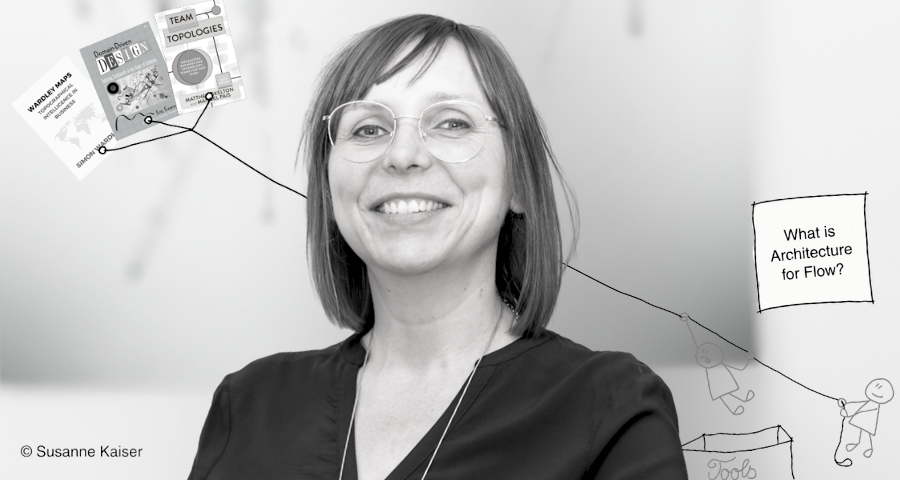
Susanne Kaiser helps organizations design adaptive socio-technical systems using Wardley Mapping, Domain-Driven Design, and Team Topologies.
«Susanne Kaiser writes with the precision of an architect and the care of a guide» as Xin Yao wrote.
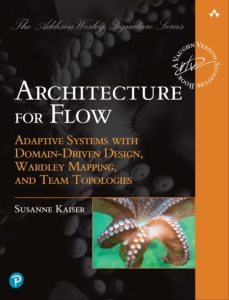
Her book, Architecture for Flow (Addison-Wesley Signature Series, 2025), brings these disciplines together into a coherent model for navigating complex, evolving systems.
Target Audience
Is this workshop for you?
You will find this workshop valuable if you:
- Work in technical leadership or architecture roles
- Lead teams that build or evolve complex systems
- Support organizational change or transformation initiatives
- Need a holistic approach to aligning strategy, architecture, and teams
- Want practical ways to reduce friction and accelerate flow.
Common roles include: Software architects, tech leads, engineering managers, domain experts, system designers, product leaders, transformation coaches.
Agenda
This workshop takes you through four connected modules.
Each builds on the previous one so you can see the system as a whole.
Module 1 – Wardley Mapping Fundamentals
- Understanding the Strategy Cycle of Wardley Mapping
- Starting with the Why of Business: The Purpose
- Visualizing the Business Landscape with a Wardley Map
- Creating a Wardley Map
- Understanding Climatic Patterns
- Applying Doctrinal Principles
- Identifying Strategic Opportunities: Leadership and Gameplay.
Module 2 – Strategic Domain-Driven Design
- Exploring DDD patterns & practices as part of the value chain
- Domain models and bounded contexts
- EventStorming Formats
- Mapping bounded contexts to evolution stages
- Assessing change coupling with Context Maps.
Module 3 – Team Topologies Essentials
- Why functional silo teams create friction
- Requirements for flow optimization
- The fundamental team types of Team Topologies
- The team Interaction modes.
Module 4 – Connecting the Dots: Architecture for Flow
- Combining Team Topologies with Wardley Mapping and DDD
- Applying the Architecture for Flow Canvas
- Working through a legacy system scenario
- Seeing how strategy → architecture → teams align.
How it works
The Architecture for Flow Workshop provides hands-on exercises, collaborative mapping and modeling sessions, and guided scenarios based on prepared examples. Participants don’t just learn the ideas of the three perspectives, but also learn how to apply them in a coherent way to their own contexts.
This isn’t a standard training on DDD, Wardley Mapping, or Team Topologies.
You will:
- Learn how all three methods work together to optimize flow and alignment
- Apply concepts to real scenarios rather than theory
- Use the Architecture for Flow Canvas to integrate strategy, domains, and team structures
- Leave with maps, templates, and models you can apply immediately
- Gain a practical mindset for continuous adaptation.
F.A.Q.
Do I need to know something beforehand in order to participate in this workshop?
No prior experience with Wardley Mapping, Domain-Driven Design, or Team Topologies is required. While some familiarity with any of these approaches can be helpful, the workshop is designed to be accessible for participants at all levels.
How can I prepare to take the course? Recommended readings? Other?
If you would like to prepare in advance, my book Architecture for Flow (Pearson, 2025) offers a comprehensive foundation for the concepts we will explore in the workshop. However, it’s not required reading; we will cover the essential concepts during the workshop.