Artificial intelligence tools have become an integral part of modern software development.
They can accelerate prototyping, support design decisions, and simplify complex tasks.
As powerful as they are, they can also be frustrating: ignoring simple instructions, hallucinating impossible solutions, or agreeing too easily with poor ideas.
This AI Assistants for your teams Workshop with Uberto Barbini teaches how to approach AI assistants and large language models not as magical entities or “coding buddies,” but as tools that respond best to well-defined methods and clear processes.
You will learn how to consistently produce valuable outcomes by adopting disciplined workflows, gaining a clear understanding of the current state of the art, and building a solid framework for evaluating and using future technologies.
This hands-on course is designed for professional developers and technical leads who want to integrate AI assistants into their daily work in a systematic and reliable manner.
Learning Objectives
By completing this course, you will:
- Develop a structured approach to AI-assisted software development.
- Understand the strengths and weaknesses of the various tools currently available to developers.
- Learn to distinguish between exploratory “vibe coding” and systematic engineering.
- Gain the ability to build, document, and maintain AI-generated solutions with confidence.
- Strengthen their ability to evaluate, guide, and verify AI output.
The Trainer 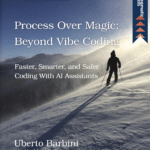
Uberto Barbini is the author of Process Over Magic: Beyond Vibe Coding and a polyglot programmer and independent software consultant with over 20 years of experience.
He helps organizations unlock the power of AI and LLM-driven tools to tackle complex software challenges, blending deep expertise in Kotlin, functional programming, and software architecture with practical, real-world insights.
Target Audience
The AI Assistants for your teams Workshop is intended for professional software developers, team leads, and architects who aim to improve their effectiveness with AI coding tools.
It is also aimed at organizations seeking to introduce AI into their development workflows while maintaining high standards of quality and governance.
Agenda
Module 1
Vibe Coding and Spec-Driven Development
The first module explores how AI tools can generate complete prototypes or proofs of concept from high-level specifications.
You will learn how to formulate precise goals and inputs for the AI, structure a productive dialogue, and maintain control of the process even when the assistant generates large amounts of code automatically.
Beyond technical experimentation, this module also discusses the limitations and risks of “vibe coding,” including loss of reproducibility, security vulnerabilities, and subtle bugs.
You will leave with practical strategies such as defining and documenting detailed specifications and giving clear instructions to AI agents to minimize these issues. You will also learn how to leverage the speed and power of AI assistants to reduce idle time and open new opportunities for delivering greater business value.
Module 2
Chat-Oriented Programming
The second module introduces the principles of Chat-Oriented Programming.
This differs from Vibe Coding as the developer stays in control and reviews all the code.
Here, the emphasis is on designing and developing greenfield projects using AI support while maintaining engineering discipline and code quality.
You will learn techniques for structuring AI interactions to ensure code quality and consistent results. We will also explore how to use AI assistants to learn unfamiliar technologies faster and more effectively than with traditional methods alone.
This module also introduces Vector Databases (VectorDBs) and the Model Context Protocol (MCP), explaining how these technologies enhance the memory and reasoning capabilities of AI systems, and how to use them.
Module 3
AI in Large and Legacy Codebases
The third module focuses on applying AI tools within large, real-world systems — from active codebases to legacy software.
You will use practical “recipes” for reading, refactoring, and extending complex projects in collaboration with AI assistants.
The goal is to understand how to use AI responsibly in environments where code quality, security, and maintainability are critical.
We will also examine how AI assistants can integrate into professional teams, exploring how they impact workflows, clarify accountability, and combine automation with human expertise.
By the end, you will have a clear framework for introducing AI into established projects without compromising reliability or team cohesion.
How it works
The course builds progressively: starting from rapid prototyping, moving toward full project design and development, and concluding with the application of AI assistants in real-world, large-scale, or legacy environments.
The course is organized into three modules of half a day (3.5 hours) each. Each module combines guided demonstrations (about 25% of the time), practical hands-on exercises (50% of the time), and Q&A and group reflections (the remaining time).
F.A.Q.
What’s the practical activity we’re gonna focus on more during the class?
Coding using AI assistants
Is there a final challenge to solve?
There is a final legacy project to improve, all together in a mob session.