Collaborative Modelling
Leverage the power of interdisciplinary expertise
In software development, collaborative modelling refers to modelling formats and practices performed collaboratively as group activities. The approach isn’t particularly new—Alistair Cockburn referred to collaborative modelling sessions in his book Agile Software Development, the Cooperative Game, and classic practices like CRC Cards can be considered a form of collaborative modelling.
In recent years, attention to these techniques increased in the Domain-Driven Design community, with the popularity of more explicitly participatory formats like EventStorming, Domain Storytelling and more. However, its popularity isn’t limited to the domain-driven design field. Formats like Wardley Maps, or even Business Model Canvas, while powerful in solo mode, can deliver extra value when practised in a Collaborative Modelling fashion. Last but not least, Lego Serious Play is another example of a collaborative modelling activity that is even more detached from the software world.
Why collaborative modelling?
Why do we need collaborative modelling? The answer is simple: it works better.
A good modelling session can address the intricacies of a problem that cannot be solved by a single person and deliver a result with built-in consensus. Incorporating multiple stakeholders into a collaborative modelling space helps overcome individual blind spots.
This is particularly relevant in Architecture Modernisation’s initiatives, where Collaborative Modelling is crucial.
Short Collaborative Modelling sessions can increase the development speed, especially in exploratory domains, enabling the so-called Modelling Whirlpool.
Discovery vs Design
The term Collaborative Modelling carries some ambiguity when it comes to formats and interaction dynamics. The most significant difference is between discovery and design workshops.
Collaborative Discovery Interactions
In a Collaborative Discovery session, the goal is to achieve a shared representation of some system. Collaboration is key because every actor in the workshop can bring a unique perspective or set of information. Think of it like an investigation whiteboard in a detective movie, where every detail is connected with the others and contributes to building a consistent picture.
Some formats enable parallel contributions by setting clear rules. Some retrospective formats, such as Starfish or Timeline, provide simple framing and allow for parallel contributions. Big Picture EventStorming starts with orange events on a left-to-right timeline. The emergent visual artefact is conveying a first round of raw information.
Wardley Maps offer an interesting example of collaborative discovery by placing constraints on the modelling surface. A designated facilitator may coordinate parallel contributions if the participants are unfamiliar with the notation. The artefact integrity requires some supervision.
Canvases, such as the Business Model Canvas, capture most of the constraints within the modelling surface itself, thereby reducing the need for explicit coordination.
A notable common trait is how much the layout becomes an integral part of the emergent message. The first round of exploration in a retrospective can communicate hope or despair in a self-explanatory way. The distribution of events in a Big Picture EventStorming can highlight dependencies and gaps.
Most contributions in Collaborative Discovery are not questioned. Sticky notes can trigger some discussions, but the typical assumption is that no contribution is wrong.
Collaborative Design Interactions
Collaborative design typically begins with a shared perception of reality to deliver one or more options for a potential solution.
In a software design session at a whiteboard, we sketch a few options, quickly highlight the pros and cons of each, and then converge on the most promising solution. The proposed solution needs to have some internal coherence – we don’t want to choose something that is clearly not working – but the solution also needs to look more promising than the alternative options and win the support of the participants.
For example, Process Modelling and Software Design EventStorming embed most of the coherence in the mandatory grammar, but leave the modelling team the burden of picking the best names and abstractions for the solution.
Collaborative Design also requires a more sophisticated approach for picking the most promising option. Future uncertainty bears down on participants, and they may not feel its consequences equally. Having different ‘skin in the game’ is not a significant issue in collaborative discovery, but it becomes crucial when designing and selecting solutions.
The role of Lo-Fi
Using throwaway materials, such as sticky notes, flipcharts, pens, and paper, affects the interaction. Cheap, disposable sketches prompt the quick construction of another version, expanding the solution space.
When solutions are too polished, we may be biased toward sticking with the first one that looks good, potentially lowering the quality of the design session’s outcome.
Facilitated Modelling?
The increasing number of participants in a modelling session often requires a facilitation strategy to manage everyone’s contribution efficiently.
Facilitation isn’t always necessary. Different formats may imply different interaction styles. A two-person collaborative modelling session on a whiteboard may happen spontaneously during development activities, while larger-scale formats may explicitly require facilitation.
Many recent collaborative modelling formats also imply some interdisciplinary contribution, so facilitation becomes a tool to mitigate the culture clash between the different specialists.
Different tools for different purposes
Collaborative Modelling can provide tools for different purposes and support key decisions. It’s easy to misinterpret the formats for alternative notations; what matters is how the formats constrain the thinking process before arriving at the polished models.
Collaborative modelling isn’t for documenting models; it supports the decision-making process of defining models together.
The picture below summarises when different Collaborative Modelling techniques can be used in a software development project, depending on the people involved and the evolution phase.
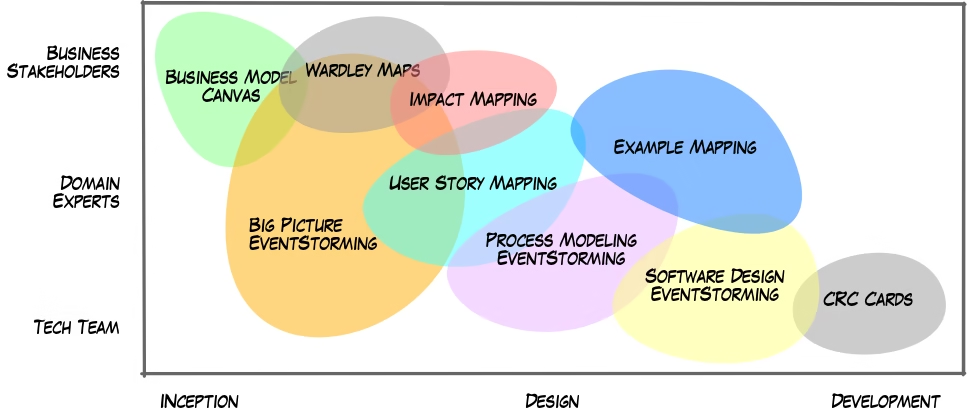
An opinionated map of some Collaborative Modelling formats, and their possible placement in a software development project lifecycle.
What makes a good session?
Sometimes, it’s just a funny feeling: the rewarding sensation of “We nailed it.” But this is no coincidence because modelling is often like solving a puzzle together.
Models require some notation, but most collaborative modelling formats lean towards minimalistic and informal notation to be accessible. The spectrum is broad: Lego Serious Play is probably the most open format, and Wardley Maps is the more structured. Even old-school software design sessions with UML on a whiteboard rely on a subset of the official notation.
The level of facilitation should probably be just enough: while too little might create awkward moments, too much might make participants feel that they delivered something, but not the right outcome.
Our special recipes
Over the years, Collaborative Modelling has been a fundamental ingredient of our consulting and training services. We invented formats and contributed to others. We used someone else’s format or invented something on the fly. Sometimes we misunderstood a format and stumbled upon something even more interesting.
Here’s a list of our favourite Collaborative Modelling recipes.
EventStorming
EventStorming is our house speciality—a family of versatile workshops built around Collaborative Modelling. A Big Picture EventStorming can help you quickly discover the intricacies of a very complex business domain to design transformational initiatives. Process Modelling allows interdisciplinary process design, capturing the needs of business, tech, and UX professionals. Software Design EventStorming takes collaboration to the next step, introducing software design concerns in business-driven discussions and paving the way for robust and performing event-driven solutions.
If you are curious about ways to facilitate and leverage collaborative modelling’s potential in your EventStorming sessions, the talk Joys and Pitfalls of Collaborative Modelling, from DDDEurope 2019, can provide some inspiration.
Model Storming
Model Storming is the meta-model behind EventStorming and other adaptive formats. It lets us start modelling even without a clear understanding of the problem space’s nature. After every round, we pick a promising facet, choose a visualisation tool that works well with the previous steps, visualise the new coordinate, and reflect on the outcome.
The result is an incredibly powerful tool that lets us visualise any problem space and eventually design the grammar for successful iterations.
Reverse Roadmapping
Reverse Roadmapping leverages the Reverse Narrative pattern to build sustainable roadmaps towards a common goal. Architecture Modernisation is a common application scenario, especially where the transition requires consensus between multiple players.
Obeyas
An Obeya Room is the pulsating heart of strategic decision-making for a colocated organisation. It’s the place where every relevant information is displayed in a way that simplifies and accelerates decisions.
Without a physical space, a digital organisation can quickly lose the holistic perspective. Departments act as silos, often driven by local goals at the expense of global ones. A Digital Obeya Room can bring a systemic perspective back into any strategic decision.
You might find more about it in Modelling up! – Alberto Brandolini – DDD Europe 2024
Learning about Collaborative Modelling
Kenny Baas-Schwegler and Gien Verschatse are providing a robust foundation for facilitating software-oriented collaborative modelling workshops in their Collaborative Software Design Workshop.
Andrea Magnorsky provides a very actionable entry point into Collaborative Modelling in Collaborative Modelling with Bytesize Architecture Sessions and C4.
Our EventStorming Masterclass is a 2-day deep dive into collaborative discovery and design, with the three flavours of EventStorming as the main dish.
Still, if you want a more general overview of what’s going on in the Collaborative Modelling space, experience hybridation, and have a deeper conversation about the whys and the hows, you should consider visiting ComoCamp in Vienna. It’s an unconference tailored around the Collaborative Modelling idea, where practitioners and learners can find common ground, explore new ideas, and have fun.